

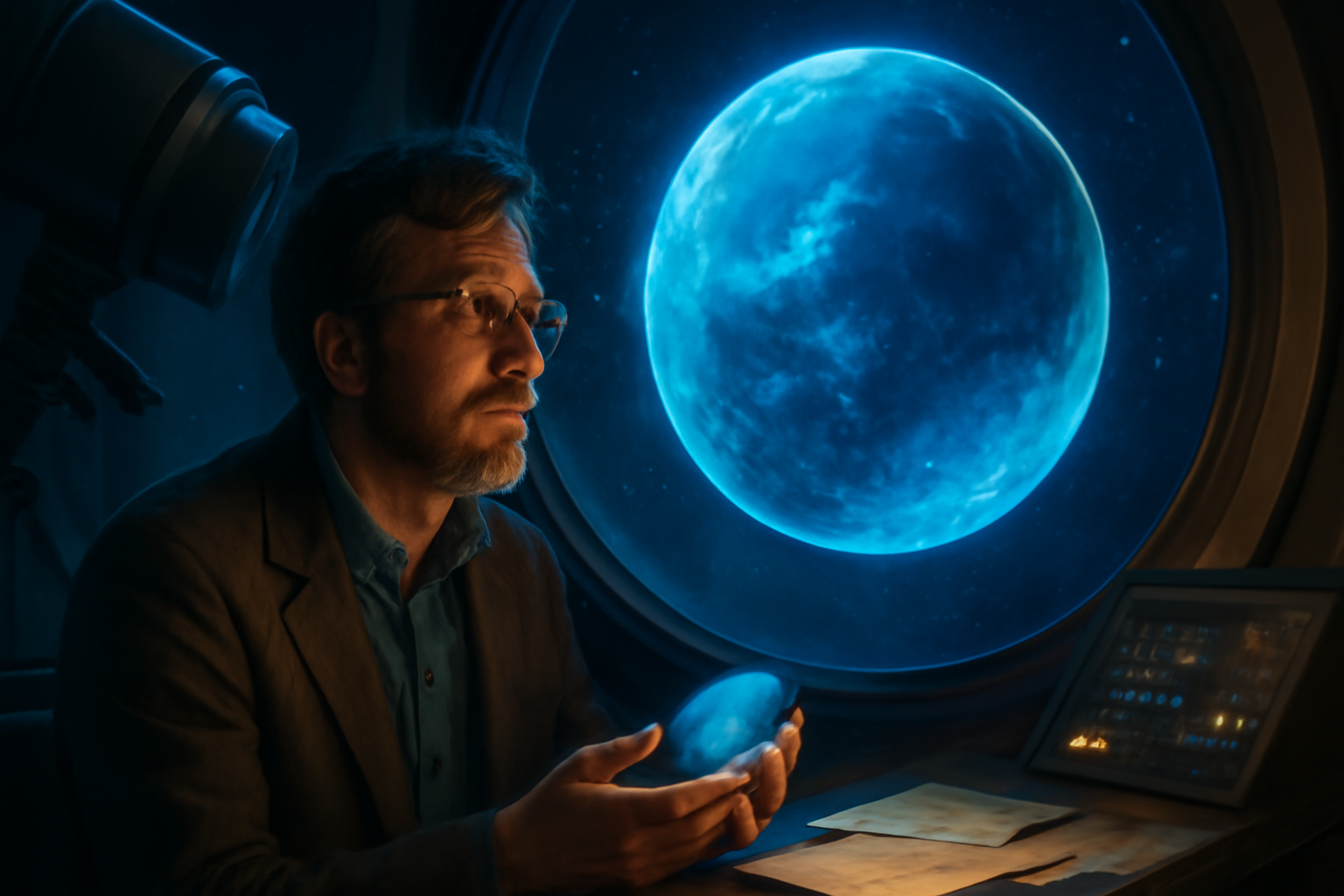
Dr. Rowan Lark had spent most of his life looking up.
He’d fallen in love with the night sky at eight years old, when his mother handed him a cheap plastic telescope and pointed him toward Jupiter. The view had been little more than a smudge of light — shaky, grainy, barely a planet at all — but Rowan had felt something inside his chest open like a window.
The stars didn’t feel distant.
They felt patient.
As if waiting for someone to notice something important.
By the time he was thirty-three, Rowan had become one of the youngest senior astronomers at the Helios Ridge Observatory, a quiet mountaintop facility where nights were long, silence was deep, and the sky stretched clear and wide enough to breathe through.
And yet — in all his years of studying the universe, Rowan had never seen anything like the light that appeared on his monitor one cold November night.
He almost missed it.
He’d been reviewing data from the observatory’s deep-field scans — routine stuff, mostly dust clouds and faint background galaxies. But then there it was:
A point of light.
Bright enough to be a star.
Steady enough to be something closer.
But it wasn’t listed on any chart.
Not in any catalog.
Not in any simulation.
It hovered alone in an empty quadrant of sky where nothing should be.
Rowan frowned and adjusted the tracking.
The point of light flickered — not randomly, but rhythmically.
Almost like it was blinking.
He leaned forward.
“It’s… pulsating?”
The pattern repeated.
Short flash.
Long flash.
Long flash.
Short.
Rowan froze.
“That’s—”
Morse code.
It was Morse code.
He stared at the screen, heart thundering.
“S-O-S.”
The universe was sending him an SOS.
He stepped back from the monitor, adrenaline ricocheting through his body. He checked the telescope’s alignment. Perfect. He checked the instrument logs. Clean. He checked the optics, the firmware, the cables, even the weather data.
No atmospheric interference.
No hardware malfunction.
No human error.
The signal was real.
And coming from a point of light that shouldn’t exist.
Rowan swallowed hard.
He aimed the spectroscope.
The wavelength readings came back — unusual, but unmistakable.
Not a star.
Not a nebula.
Not a comet.
A planet.
A small one, but close enough that the signal wasn’t impossible.
Closer than Mars.
Closer than the Moon.
But invisible to every naked eye and every other telescope in the world.
“How are you hiding?” he whispered to the screen.
The light pulsed again — this time not SOS.
This time a new pattern.
Quiet. Slow. Gentle.
A greeting.
Rowan didn’t sleep.
He spent the night tracking the object across the sky.
Every time he rechecked the monitors, the tiny planet shimmered faintly, like a bubble reflecting light from a candle.
The blinking continued — not constant, but with enough variation that Rowan began writing it down. The pulses formed patterns. Patterns formed sequences. Sequences formed a kind of language.
It wasn’t Morse code anymore.
It was… musical.
The light flickers had rhythm. Tempo. Crescendos and diminuendos.
Like a cosmic lullaby.
Rowan found himself humming along, tears pricking the edges of his eyes without warning.
It felt like the planet was singing.
Singing to him.
By dawn, he knew two things:
-
The planet was trying to communicate.
-
For some reason, it chose him.
This made no sense.
Rowan wasn’t a decorated scientist.
He wasn’t world-famous.
He was just… Rowan. Quiet, observant, gentle Rowan who spent most nights alone, working through data while the rest of the world slept.
He stood outside the observatory as the sun rose, bathing the mountains in golden light.
The sky looked ordinary again.
As if holding a secret.
His chest ached with a kind of longing he hadn’t felt since childhood — that yearning for connection he never quite found with people, but always, somehow, felt with the stars.
“What are you?” he whispered to the empty blue.
But he knew the better question was:
“Why me?”
He didn’t tell anyone.
Not yet.
Rowan wanted — needed — to understand the planet before turning it over to the world. He didn’t want it to become a headline, a sensation, a government project.
It felt too fragile.
Too rare.
Too alive.
So night after night, he returned.
And night after night, the planet waited.
Blinking its slow, musical greeting.
Pulsing soft waves of light that made Rowan feel something he had never felt in all his years among telescopes and star catalogs:
Seen.
One night, exhausted and lonely and wrapped in a blanket, Rowan whispered to the screen:
“Are you watching me, too?”
The planet pulsed — fast, bright, unmistakable.
Yes.
Rowan laughed — startled, shaky, full of warmth.
“You know I’m here.”
Yes.
“And… you wanted me to notice you?”
Yes.
Rowan exhaled a long, trembling breath.
“Why?”
The planet paused.
Its light dimmed.
Then flickered.
Not in words this time — but in imagery.
Colors.
Waveforms.
Graphs.
Light curves.
Rowan stared, piecing together the shape of the data.
They weren’t scientific values.
They were memories.
Of landscapes.
Skies.
Oceans of luminous dust.
Forests of crystal towers.
Creatures made of shimmering threads.
A whole living world.
Rowan’s heart clenched.
“You’re… alive.” He whispered.
The planet glowed softly.
Yes.
A living planet.
A conscious planet.
Alone in a universe too vast to feel anything but invisible.
Until Rowan looked up.
The next signal came at 3:12 a.m.
A flicker.
Then a fade.
Then a trembling pulse of light.
Rowan sat up straight.
The light was unsteady.
Weak.
“What’s happening?” he whispered.
No answer.
The blinking grew slower, dimmer.
The planet’s outline on the monitor shimmered unevenly.
Rowan’s throat tightened.
“You’re dying.”
The reply came faint and broken.
Cold.
Drifting.
Forgotten.
Rowan stared, tears welling.
“You’re not forgotten,” he whispered fiercely. “Not anymore. I’m here. I see you.”
The light steadied slightly.
Warmth.
Recognition.
Relief.
Rowan pressed a hand to the screen as if he could reach through.
“Tell me how to help.”
Light flared suddenly — bright enough to cast shadows across the control room.
Rowan jumped back.
The flickering formed a tight, rapid pattern.
Coordinates.
But not celestial.
Geographic.
Earth coordinates.
Rowan typed them in and blinked.
The location was less than two miles from the observatory.
“What do you need me to find?” he asked.
The planet flashed gently.
A memory.
Rowan grabbed his coat.
The coordinates led him down a narrow trail into the forest behind the ridge. The air was cold, pine-scented, quiet.
He found it at the base of an old tree.
A stone.
Palm-sized.
Smooth.
Glowing faintly — the same rhythm as the planet’s light.
He knelt and touched it.
Warm.
Alive.
The stone pulsed — once, twice — and then Rowan understood.
It wasn’t a stone.
It was a seed.
A piece of the planet.
A fragment it had sent out long ago, drifting through space until it fell to Earth. Forgotten. Buried. Waiting.
And now it was calling home.
Rowan pressed the seed to his chest, breath shaking.
“You’re not alone,” he whispered. “I’ll return you.”
The seed pulsed.
Thank you.
Back at the observatory, Rowan placed the seed on the desk.
The planet’s blinking steadied immediately.
Calm.
Grateful.
Alive.
The light surrounding the seed rose in a soft halo.
Rowan felt warmth flood his chest — a gentle, radiant connection that shimmered like stardust through his bones.
The planet wasn’t dying.
It was calling something home.
Reuniting with a piece of itself.
Finding itself again through him.
Rowan whispered:
“I’ll keep you safe.”
The planet responded with a pulse so bright it made the room glow.
And Rowan felt something he had never felt in his entire life:
Belonging.
As if the universe itself had finally whispered back:
I see you, too.